"Mobivibe.online: Your Daily Dose of Honest Tech Reviews & Guides"

Internet Shutdown 2026: Is it Real? Fact-Checking Solar Storm Rumors | Mobivibe.online
Is the global internet going to shut down in 2026? Mobivibe fact-checks the viral solar flare rumors and explains the technical truth about connectivity and CMEs.
MOBIVIBETECHTECH NEWS
3/29/20263 min read
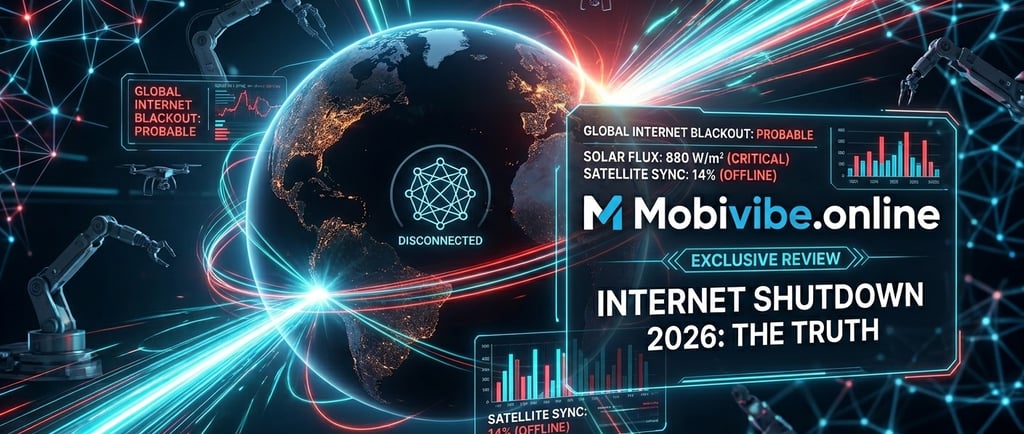
Global Internet Shutdown 2026: Fact-Checking the Solar Storm Panic
The Connected Crisis: Could the Entire Web Go Offline?
In March 2026, a strange panic has taken hold of the internet. From New York to Mumbai, millions of people are searching for one terrifying phrase: "Internet Shutdown 2026." The source of the anxiety? An impending super-solar flare, a massive coronal mass ejection (CME) from the Sun, which some rumors claim will destroy undersea fiber-optic cables and satellites, plunging the world into a months-long digital darkness. But is this apocalypse real, or is it another viral exaggeration? Mobivibe.online went deep to find the scientific truth.
The Global Digital Panic of 2026
In March 2026, a wave of digital anxiety has swept across the globe. From tech-savvy hubs like Silicon Valley to the bustling streets of India, millions are searching for a single, terrifying question: Is the global internet really going to shut down? At Mobivibe.online, we’ve seen the viral TikToks, the frantic WhatsApp forwards, and the ominous YouTube thumbnails claiming a "9-month internet blackout." But before you start printing your emails or buying offline maps, let’s separate the science from the clickbait. Here is the exclusive fact-check on the 2026 Solar Storm and its impact on your digital life.
1. The Science: What is a Solar Flare?
The Sun follows an 11-year cycle of activity. In 2026, we are approaching the Solar Maximum, a period where the Sun is most active, frequently releasing Coronal Mass Ejections (CMEs). These are massive clouds of solar plasma and magnetic fields that can reach Earth in 15 to 72 hours.
When a powerful CME hits Earth, it causes a "Geomagnetic Storm." While these storms create beautiful auroras (Northern Lights), they can also induce electrical currents in long-distance conductors, such as power grids and certain types of communication cables.
2. The "Internet Apocalypse" Theory: Where did it start?
The term "Internet Apocalypse" gained popularity following a research paper presented at the SIGCOMM conference. The study suggested that while local fiber-optic networks are safe, the undersea cables that connect continents might be vulnerable.
These undersea cables use "repeaters" to boost the signal over thousands of miles. Unlike the fiber-optic cable itself (which is made of glass and carries light), these repeaters are powered by electricity. If a massive solar storm induces a surge in these power lines, it could potentially damage the repeaters, leading to a large-scale connectivity failure.
3. Fact-Checking the 2026 Rumors: Is it Real?
Will the whole world go dark? NO. A global, permanent shutdown is highly unlikely. Most modern internet infrastructure is built with redundancy. If one undersea cable fails, traffic is rerouted.
Is NASA predicting a shutdown? NO. NASA and NOAA (National Oceanic and Atmospheric Administration) monitor solar activity 24/7 to warn us, not to predict the end of the internet. They issue alerts so power grid operators and satellite companies can take protective measures.
Is it happening in March 2026? While solar activity is high this month, there is no scientific evidence that a specific "web-killing" flare is scheduled for a particular date. Solar flares are unpredictable.
4. Regional Vulnerabilities: USA vs. India
Interestingly, search data shows that users in the USA, Canada, and Northern Europe are more concerned. This is because high-latitude regions are more susceptible to geomagnetic disturbances. In India, our geographical location provides a natural layer of protection, making a total blackout even less likely for local users.
5. How Mobivibe Suggests You Prepare (Without Panic)
Instead of worrying about a digital dark age, follow these professional tips from Mobivibe.online:
Stay Updated via Trusted Sources: Don't trust every viral message. Follow scientific agencies like NASA or trusted tech blogs like Mobivibe for real-time updates.
Invest in Surge Protectors: Even if the internet stays up, local power surges can damage your routers and PCs. A high-quality surge protector is a must-have in 2026.
The Mobivibe Verdict
The "Internet Shutdown 2026" is largely an exaggerated rumor. While solar storms are a real scientific phenomenon that can cause temporary regional outages (mostly to satellites and power grids), the idea of the entire world being offline for months is not supported by current data.The internet is more resilient than we think. Stay calm, stay informed, and keep your devices updated.
Google Data Offline: Securing Your Digital Legacy in 2026 | Mobivibe.online
Internet Shutdown March 2026: Truth Behind Solar Flare Rumors | Mobivibe


undersea-cable-vulnerability-solar-flare-2026
"Welcome to Mobivibe - Your Digital Compass for Tech & Gadgets!"
नमस्ते ! मैं हूँ bhikam, और Mobivibe की शुरुआत एक सरल विचार के साथ हुई थी: तकनीक (Technology) को हर किसी के लिए आसान और सुलभ बनाना।
आज के दौर में जब हर दिन नया स्मार्टफोन या इलेक्ट्रिक कार लॉन्च हो रही है, सही चुनाव करना मुश्किल हो जाता है। Mobivibe पर हम आपको मोबाइल फोन, लैपटॉप और लेटेस्ट गैजेट्स के ईमानदार रिव्यू, बजट गाइड्स और 'वैल्यू फॉर मनी' सुझाव देते हैं।
हमारा मकसद सिर्फ जानकारी देना नहीं, बल्कि आपको वह 'वाइब' देना है जिससे आप अपनी मेहनत की कमाई सही जगह इन्वेस्ट कर सकें। जुड़े रहें, और तकनीक की इस दुनिया में हमारे साथ अपडेट रहें !
क्या आपके पास कोई सवाल है? या आप चाहते हैं कि हम किसी खास गैजेट का रिव्यू करें? हम आपकी सुनने के लिए यहाँ हैं^
Contact✅
Newsletter
brffbrff36@gmail.com
123-123-1234
© 2024. All rights reserved.